
MOOD (mood.com)
Influencer Campaign Analysis
A system for brands in regulated markets to advertise with influencers and stay compliant every time.
Chart · Cast · Comply · Convert · Compound
What this walkthrough covers
This is a detailed walkthrough of the system: how the value propositions are found and creators matched to them, how creators are selected on hard metrics (including the ones that looked strong at first but were discarded after a closer look), and how multi-touch attribution is set up. Done right, influencers become ambassadors that keep selling for years, as predictable as ads and as profitable as organic content.
Step 1 of 5
1. Chart
Set the rules, the value, and the goal
- ›The value proposition
- ›The competition
- ›The target audience
Chart›Cast›Comply›Convert›Compound
Chart
The campaign analysed
The 5-C System was applied to an influencer marketing campaign run by Mood (mood.com), a direct-to-consumer cannabis and hemp dispensary that sells legal, hemp-derived THC products across the United States.
It is a highly regulated space. Marketed the wrong way, it can lead to serious fines.
Chart
From over 50 creators to five winners
Over 50 creators were vetted up front, narrowed to an initial list of 25 and then to five winners: Julian Dorey, Triggernometry, Jesse Michels, Chris Van Vliet and Camp Gagnon. Across the quarter, 23 sponsored videos ran with the five. What follows is how they were chosen and how every video stayed compliant.
Most brands in regulated spaces are hesitant to use influencers for two reasons: some have not gotten around to it, and many others do not want to break the rules and risk tens of millions of dollars in fines.
Chart
Two cautionary cases in this space
Cannabis and CBD
- ✓FTC 'Operation CBDeceit' (Dec 2020, final orders Mar 2021): six CBD sellers penalized for claiming CBD treats cancer, Alzheimer's and more, including on social media. Judgments ran from 20,000 dollars to 85,000 dollars.
Influencer marketing
- ✓FTC v. Teami (Mar 2020): a 15.2 million dollar judgment for deceptive health claims plus paid influencers (Cardi B, Jordin Sparks, Brittany Renner) who did not clearly disclose payment. The canonical undisclosed-influencer case.
Chart
The target avatar (Kush Mintz pre-roll)
1. Age. A legal adult who skews younger than the wellness shopper, roughly 21 to 40. The tell is a smokeable pre-roll at 29 percent THC sold for a happy body buzz, which points to an experienced recreational user rather than a cautious gummy-by-the-bed shopper.
2. Gender. A mix of men and women, but the sensual mood boost and date-night angle pull couples in. You can see it in the cross-sell to Sexual Euphoria gummies and a date-night FAQ, so the product leans toward shared and intimate use.
3. Location. Lives in one of the 20 states that flower ships to. The page spells out where it goes and tells everyone else to switch to gummies, so location is a hard gate on this product.
4. Income and spending. Value-conscious but happy to commit. The hero offer is Subscribe and Save with a never-run-out pitch, which means a repeat, habitual buyer rather than a one-time premium splurge.
5. Likes and dislikes. Cares about taste, potency, and discretion. The copy leads with minty cookie flavor, high THC, and heat-sealed packaging that looks like ordinary mail.
6. The language they use. Talks in moods and effects, not milligrams. The whole catalog is sorted by feelings like happy, aroused, chill, and social, so the buyer shops by the vibe they want.
7. Problems they face. Wants legal weed without a dispensary trip, a medical card, or the smell. The page answers all three with no card required, federal legality under the Farm Bill, and discreet packaging.
8. Circumstances. A regular user who runs out and reorders, often buying to unwind or for intimacy. The subscription-first layout and the effect tags both point to routine, occasion-based use.
9. Outcomes they want. A fast, reliable, pleasant high they can count on. Near-immediate onset, 29 percent THC, third-party lab testing, and a 100-day guarantee all sell predictability.
10. Where they spend attention. Follows cannabis culture and trusts other shoppers over ads. Nearly 3,000 reviews at 4.48, a base of 983,000-plus customers, and a concierge replying to reviewers are the social proof this buyer leans on.
Why it matters. This pre-roll is a different avatar than the CBD wellness buyer. Flower is a recreational, experienced, smoke-it user gated by shipping state, while the CBD line is the broad buyer that ships almost everywhere. That gap is the whole reason the CBD line is the clean place to prove influencer ROI.
Chart
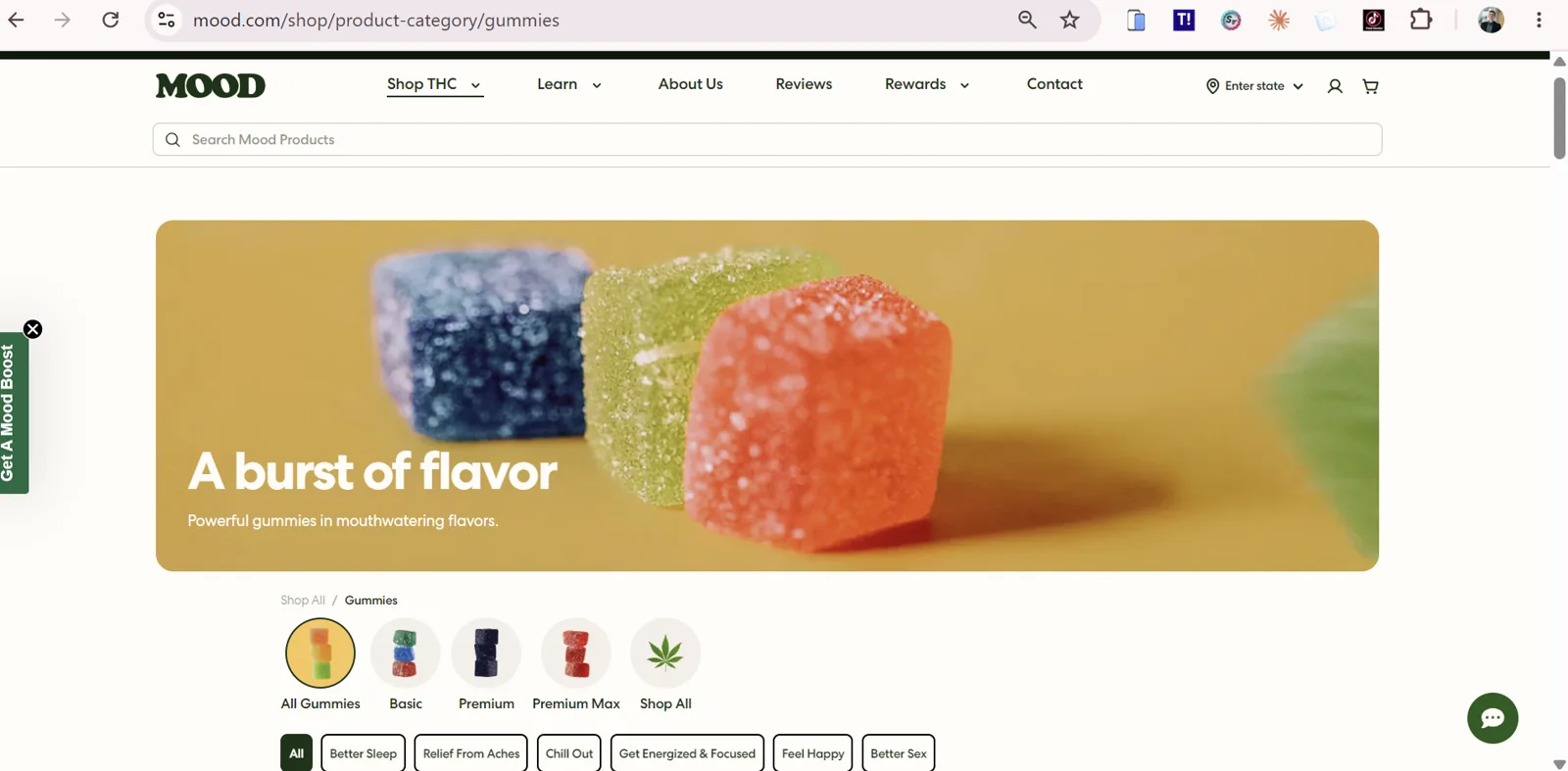
Mood: legal cannabis, delivered
Chart
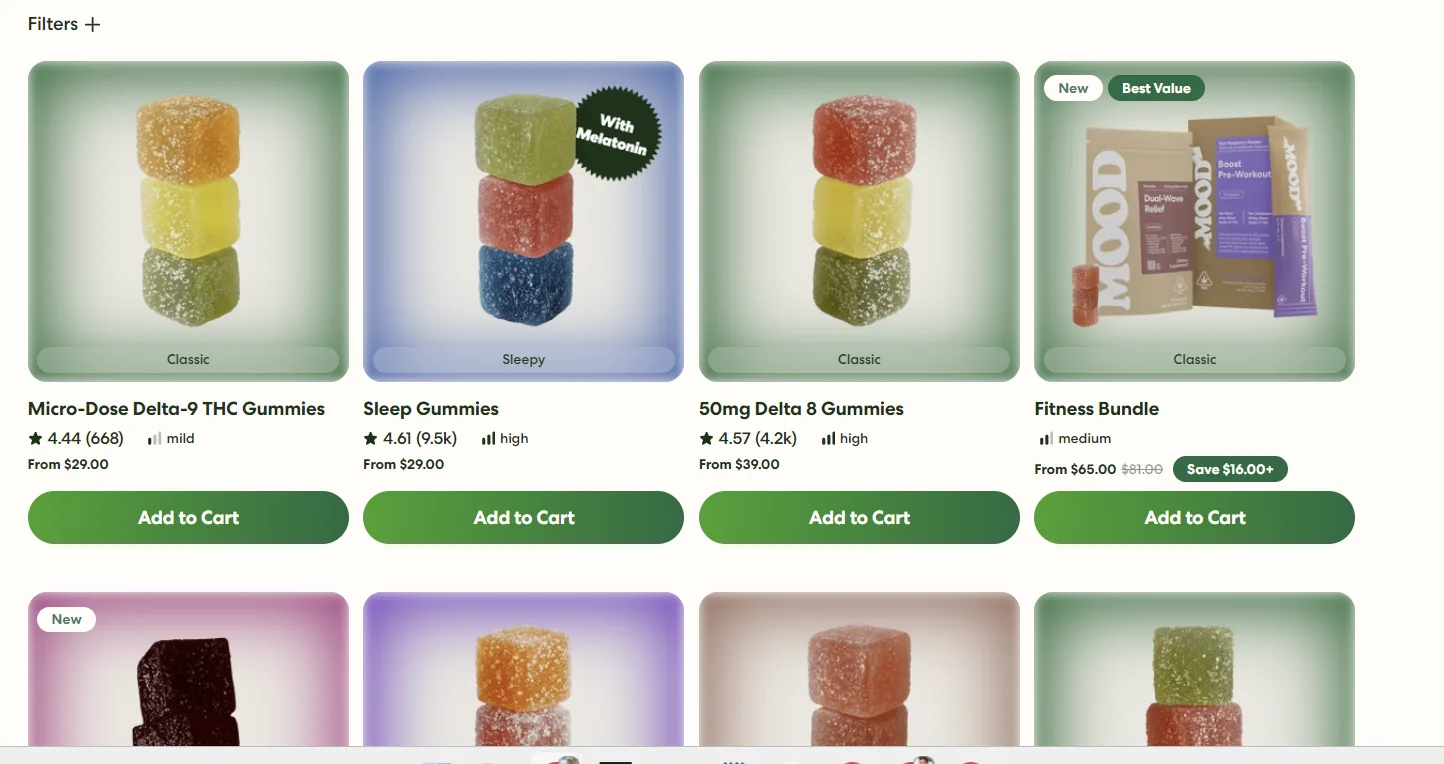
The Mood product range
Chart
The value propositions emphasised
1. Legal cannabis delivered to your door, no dispensary, no medical card. Removes the biggest barrier to legal THC: hemp-derived and Farm Bill-legal, shipped discreetly to the door.
2. Verified trust through third-party lab testing on every page. In a category full of fake claims, proof of what is inside is why people buy and re-order: outside lab results on every product page, plus a Certificate of Analysis in every order.
3. Risk-free and proven, built for repeat buying. Turns one order into a habit: 900,000-plus customers, a 100-day money-back guarantee, and 15 percent subscriber savings on every renewal.
Chart
Why lifetime value beats day-one ROAS
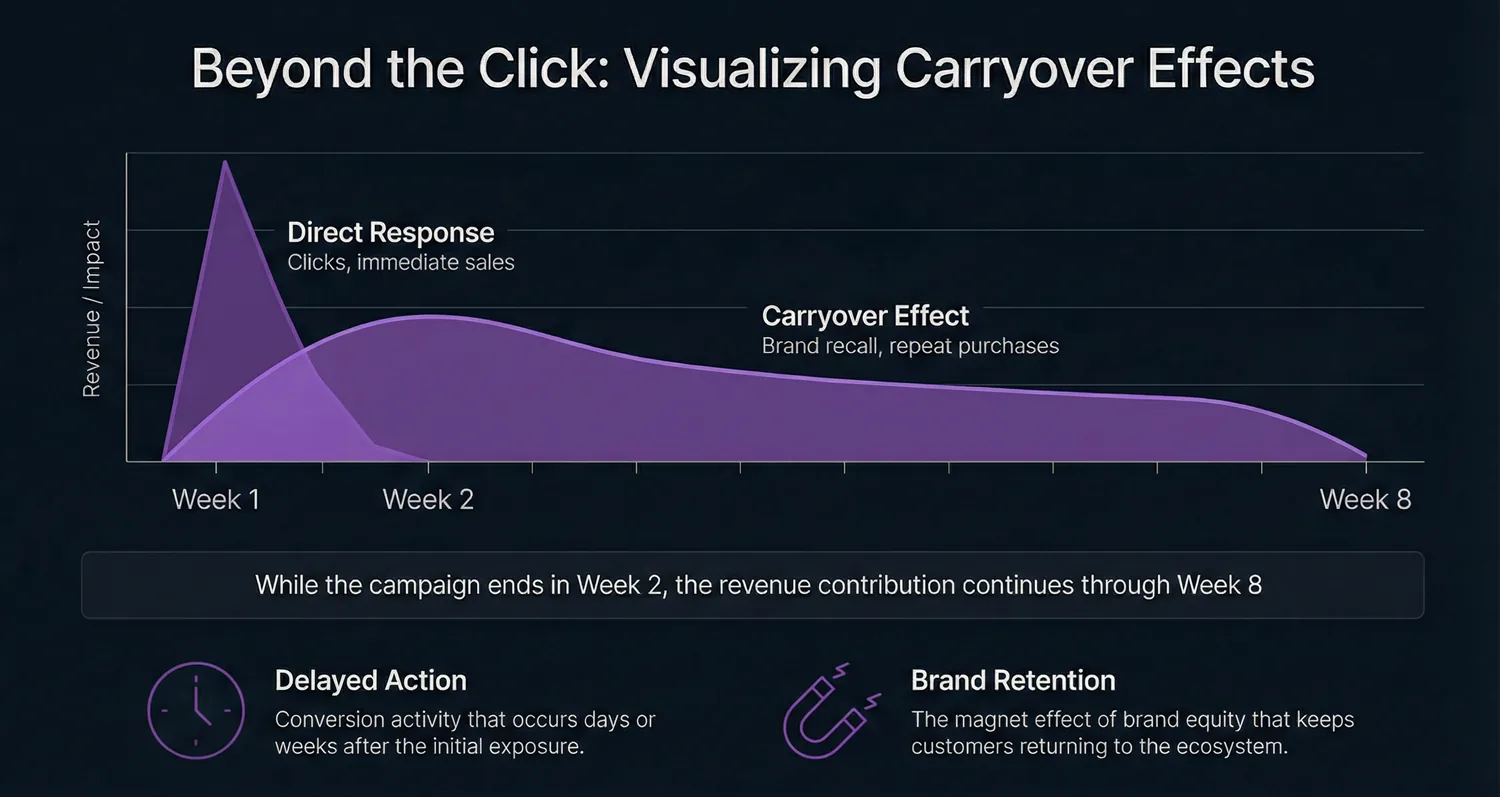
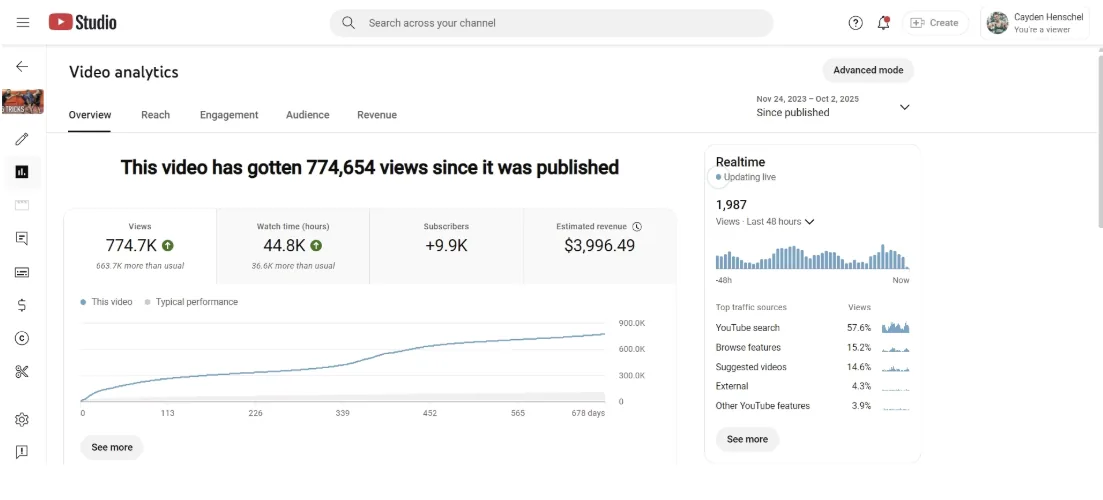
Once someone tries it, the chance of sticking is high, because the product quality is genuinely good. That lets Mood spend heavily to acquire customers, since the majority of the profit is made over the life of the customer as the subscription renews.
This eased the pressure to make 2 to 3x ROAS in 30 days and shifted the goal to breaking even on Customer Acquisition Cost (CAC). Break even on CAC at scale, and it becomes possible to invest upwards of a million dollars into influencer spend, bringing in customers who keep renewing - where the majority of the profit comes from.
This is especially true on YouTube.
Chart
Optimising for the back end
Chart
Value compounds over the customer's life
Chart
The competitor landscape
The competitor landscape, mapped out
The competitor landscape was mapped to see who else was buying YouTube influencer placements in the cannabis, hemp, CBD, and wellness space.
The set ranged from direct Delta-9 and Delta-8 rivals to adjacent CBD and hemp brands, each with a different value proposition and creator strategy, mapped in the two tables that follow.
Most used similar creator lanes: long-form podcasts, wellness creators, male-focused shows, and lifestyle channels. Their offers usually leaned on discounts, free samples, sleep, recovery, convenience, or legal hemp products.
Mood instead won by targeting an older, more mature crowd, with an emphasis on the safety behind the products.
Chart
Who else buys creator placements (1 of 2)
Who else was buying YouTube creator placements in this space
| Brand (what they sell) | Value proposition | Creator strategy |
|---|---|---|
| Mood (mood.com) Delta-9 and Delta-8 THC gummies and prerolls | Legal hemp-derived THC by mail, mass-market, with a 90-day guarantee. The biggest spender here. | Reach. A few mega-podcasts rebooked for years, led by Julian Dorey (16 videos) and H3. |
| Sunset Lake CBD (sunsetlakecbd.com) Vermont-grown CBD, full range | Farmer and employee-owned, donates to local causes. Sells on ethics, not hype. | Reach. Anchored almost entirely on one values-aligned show, The Majority Report. |
| Cornbread Hemp (cornbreadhemp.com) USDA-organic CBD and THC | The first USDA-organic CBD brand, Flower-Only extraction, a soil-to-oil premium. | Reach. The widest premium roster, mostly one-offs, headlined by Jesse Michels. |
| Jupiter (getjupiter.com) Organic CBD drops, plus a pet line | Clean, certified-organic CBD for sleep, stress and pets. Wellness, not recreational. | Repeat-loyalty. One micro creator, DissiNotRA, rebooked 14 times on an affiliate link. |
| Winged Wellness (wingedwellness.com) CBD made for women, plus skincare | The first CBD brand built for women: sleep, stress, sex, skin. Female-led. | Repeat-loyalty. One beauty creator, Peaches Skin Care, rebooked 12 times. |
Chart
Who else buys creator placements (2 of 2)
Who else was buying YouTube creator placements in this space
| Brand (what they sell) | Value proposition | Creator strategy |
|---|---|---|
| Range CBD (rangecbd.com) THC-free CBD recovery topicals | Clean, THC-free and function-first (recovery, sleep, focus). Premium, about $70 a topical. | Repeat-loyalty. One lifestyle creator, Melanie Patricia Cruz, rebooked 5 times. |
| Cannaclear (cannaclear.com) Bulk Delta-8, HHC and THCa, budget | Cheap, legal cannabinoids in bulk. A value buyer's brand. | Repeat-loyalty. Anchored on a science creator, Hamilton Morris, rebooked 4 times. |
| Cbdbroshop (cbdbroshop.com) Smoking hardware: bongs, grinders, vaporizers | Branded accessories for the cannabis lifestyle, not ingestibles. An identity and merch play. | Repeat-loyalty. One mid creator, ItsCbdBro, rebooked 4 times. |
| CBDistillery (thecbdistillery.com) Affordable mainstream CBD | Quality CBD for the masses at a fair price. More than 2M customers since 2016. | Broad one-off. Seven creators, none rebooked, topped by Salty Cracker. |
| 3Chi (3chi.com) Delta-8 and a full cannabinoid range | The Delta-8 pioneer, the first federally-legal THC in 2019. Category authority. | Broad one-off. Barely uses YouTube, about two creators, none rebooked. |
Step 2 of 5
2. Cast
Pick the right creators
- ›Putting together the creator roster
- ›Scoring each by "unorthodox metrics"
- ›Dropping irrelevant creators
Chart›Cast›Comply›Convert›Compound
Cast
Where selection started
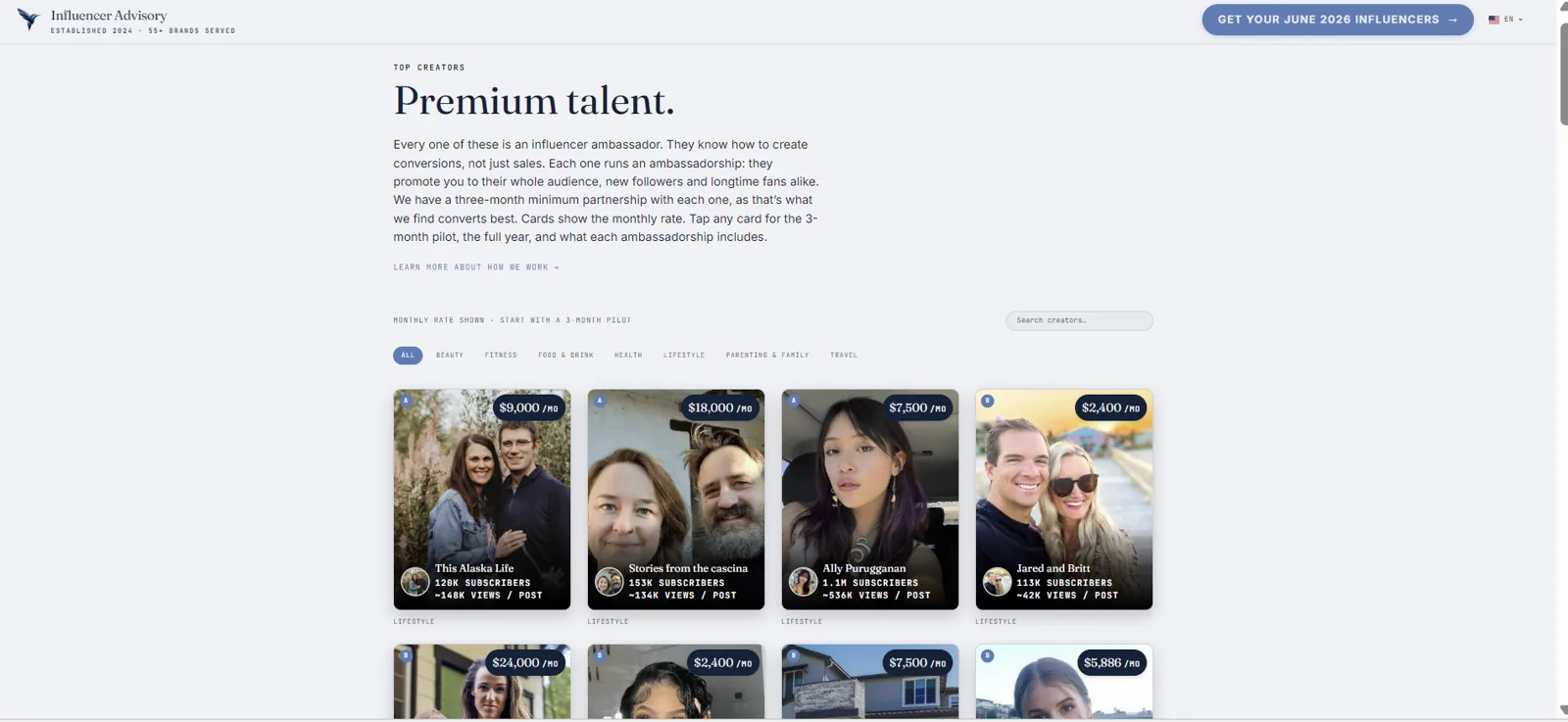
A roster, a partner agency, and the sponsorship database
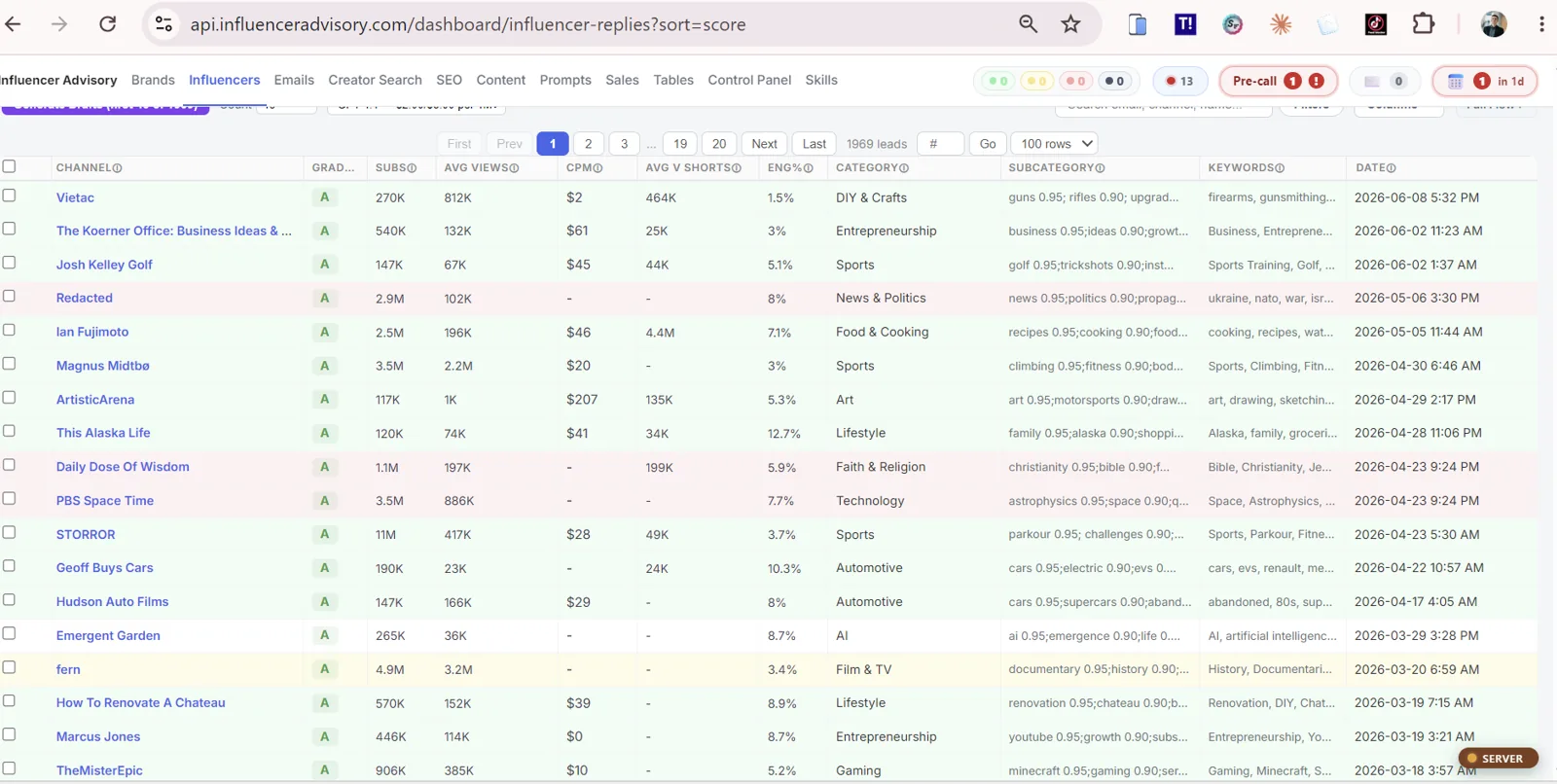
Selection started from a roster of past-performing creators, plus extra creators sourced through a partner agency, Whalar. Every candidate was then run against the sponsorship database, which holds nearly 285,000 sponsored videos across more than 31,000 YouTube channels and 44,000 brands, going back years.
Cast
Sorting the field by funnel position
Candidates were sorted by where they sit in the funnel, based on the value props
Top of funnel
- ✓Highest volume, low conversion, cheap CPM, almost no competitors. Lifestyle, music, skate or food creators with a cannabis-friendly crowd.
Middle of funnel
- ✓Mid volume, mid conversion, mid CPM, fewer competitors. Creators who weave cannabis and drinks into their lifestyle, like food and getaway pages.
Bottom of funnel
- ✓Least volume, highest conversion, most expensive CPM. Cannabis creators who post edibles, tinctures and CBD as their main content.
Cast
A roster of past-performing creators
Cast
From an initial list of 25 to five
An initial list of 25 creators was narrowed to five: Julian Dorey, Triggernometry, Jesse Michels, Chris Van Vliet and Camp Gagnon. Here is how the list got there.
For every channel the database shows which brands sponsored it, when, how many times, the views, and the promo offer. The scorecard that follows is the data behind the five.
Cast
The five, by the numbers
Channel reach from the enriched creator table; sponsor facts from the deals database
| Creator | Subs | Avg views | View:sub | Spon. vids | Brands | Brands 3+ |
|---|---|---|---|---|---|---|
| Julian Dorey | 1.28M | 297K | 0.24 | 151 | 37 | 19 |
| Triggernometry | 1.80M | 421K | 0.28 | 10 | 10 | 0 |
| Jesse Michels | 624K | 559K | 0.99 | 69 | 26 | 10 |
| Chris Van Vliet | 827K | 118K | 0.22 | 86 | 31 | 8 |
| Camp Gagnon | 505K | 140K | 0.25 | 58 | 27 | 9 |
Average views are channel-level over a recent all-video window; view-to-sub is average views over subscribers. Sponsored videos, brands and brands-at-3+ come from the sponsorship database.
Cast
An alternative shortlist we also vetted
A second roster of larger, mature, male-skewing shows, scored the same way (DB figures)
| Channel | Subs | Sponsor history (our DB) | Funnel role | Why it fits Mood |
|---|---|---|---|---|
| Shawn Ryan Show | 6.1M | 29 deals / 19 brands | Top, awareness | Huge US male 25-45 audience, already runs wellness and supplement reads (AG1, ARMRA, BUBS). Best top-of-funnel reach in the lane. |
| Chris Williamson (Modern Wisdom) | 4.2M | 18 deals / 13 brands | Middle, consideration | Health-forward male audience that already buys the exact sponsor types (LMNT, Eight Sleep, Function Health). US, mature, high trust. |
| Danny Jones Podcast | 1.2M | 36 deals / 19 brands | Middle, consideration | Already ran a hemp sponsor (Amentara). Male 21-45, US. A warm mid-funnel read. |
| The Fighter and The Kid (TFATK) | 541K | 87 deals / 37 brands / 14 at 3+ | Top / middle | Proven cannabis-category fit, already ran CBDistillery and FiveCBD. A heavy, reliable repeat integrator. |
| Hamilton Morris | 276K | 36 deals / 12 brands / 6 at 3+ | Bottom, authority | Audience cares about lab-tested, federally-legal product, the exact Mood buyer. Already ran Amentara and Cannaclear. |
Cast
Every sponsored video, scanned
Cast
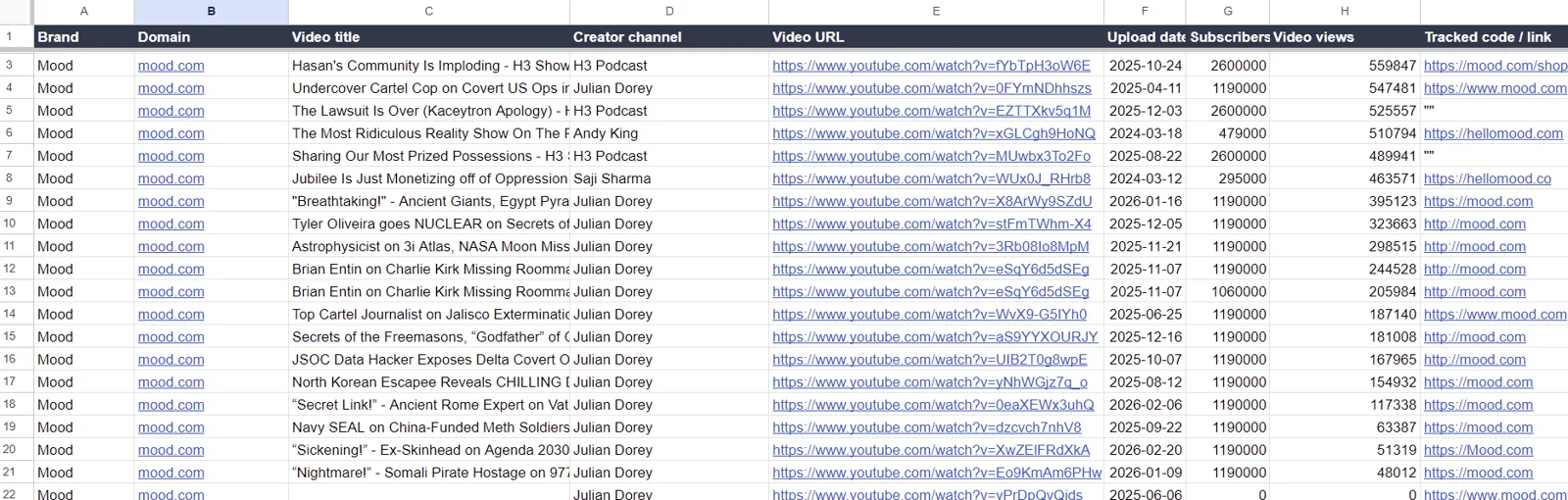
Years of brand-by-brand sponsor history
Cast
Repeat Sponsorship Signal
The single strongest signal: how often brands re-book the same creator
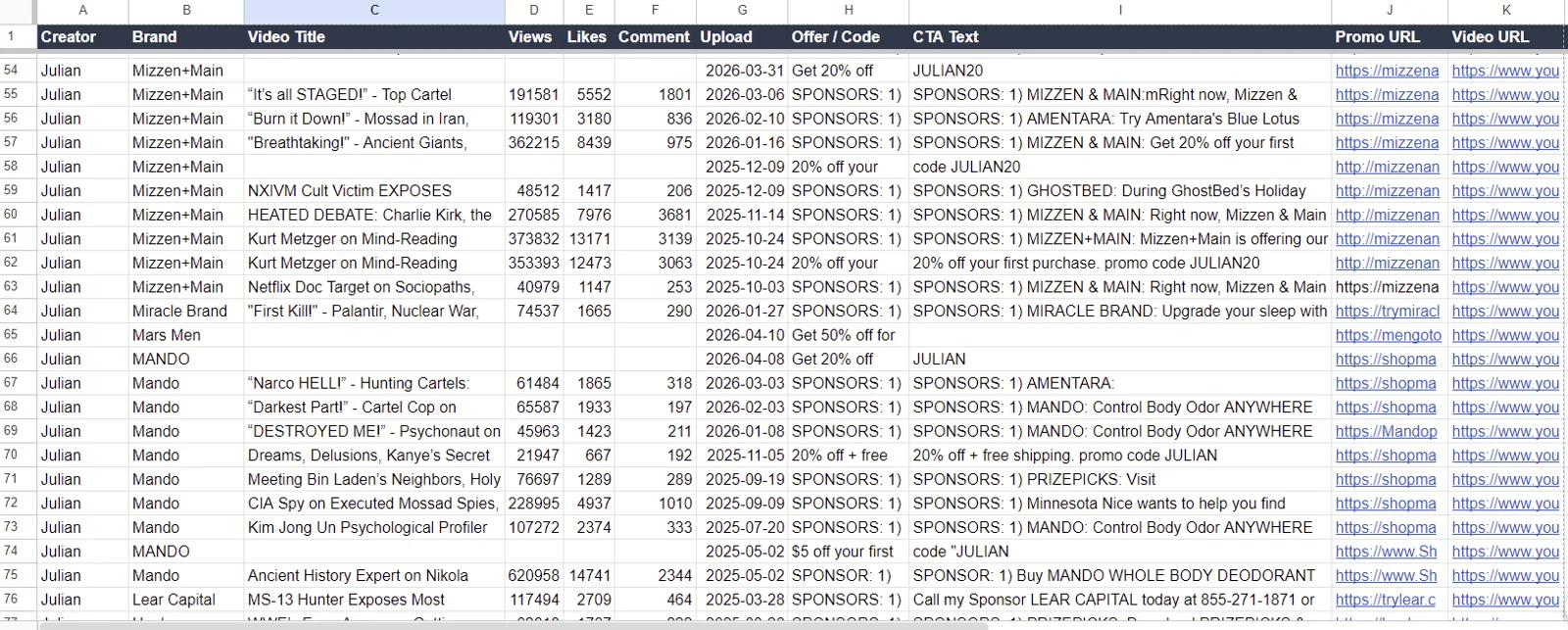
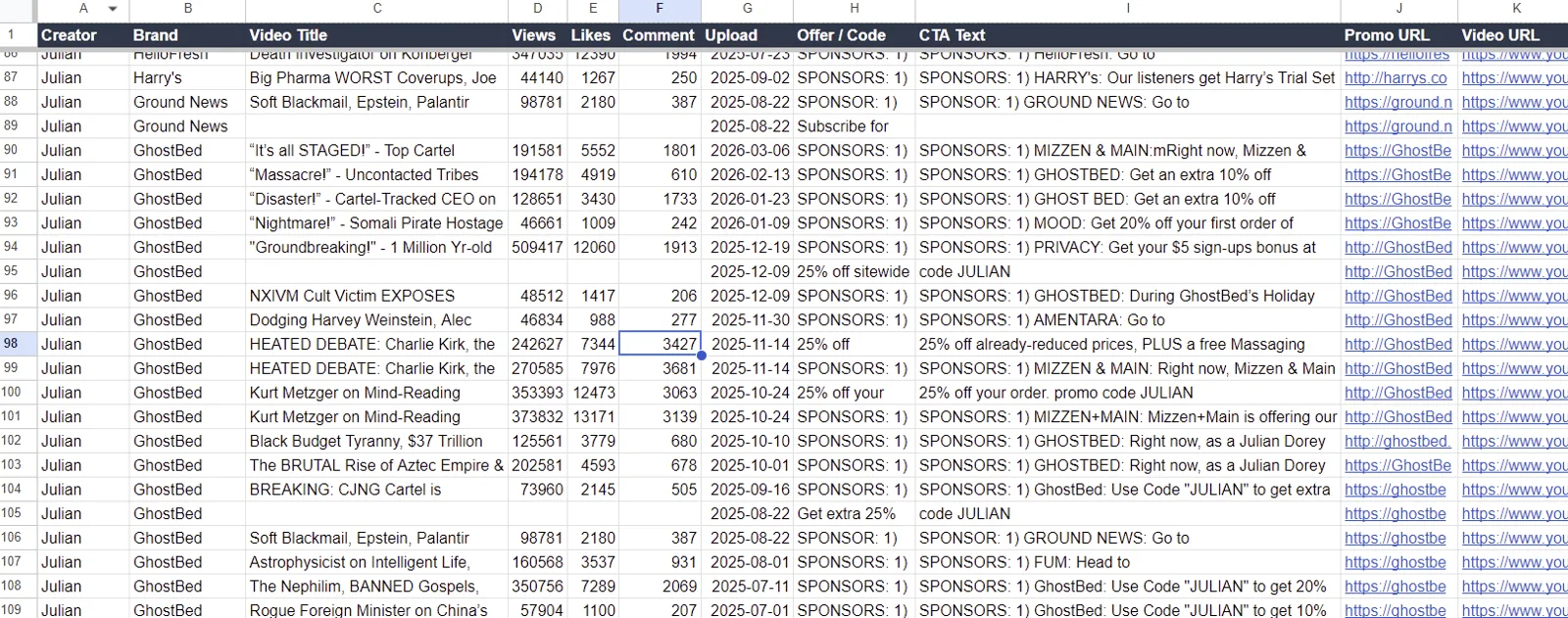
Julian Dorey has about 1.3 million subscribers. The database shows this one creator holds 151 sponsored videos, bought by 37 different brands, with 19 of those brands coming back three or more times.
A mattress brand, GhostBed, booked him 20 separate times. A hemp brand (Amentara) came back 14 times, a menswear brand (Mizzen+Main) 10, and a grooming brand (Mando) 10. Five companies in five different categories, all at or above the ten-booking mark - a sign his integrations drove traction regardless of what was being sold.
Cast
Reading the repeat-sponsor signal
Cast
Julian Dorey's record
Cast
Reach over subscriber counts
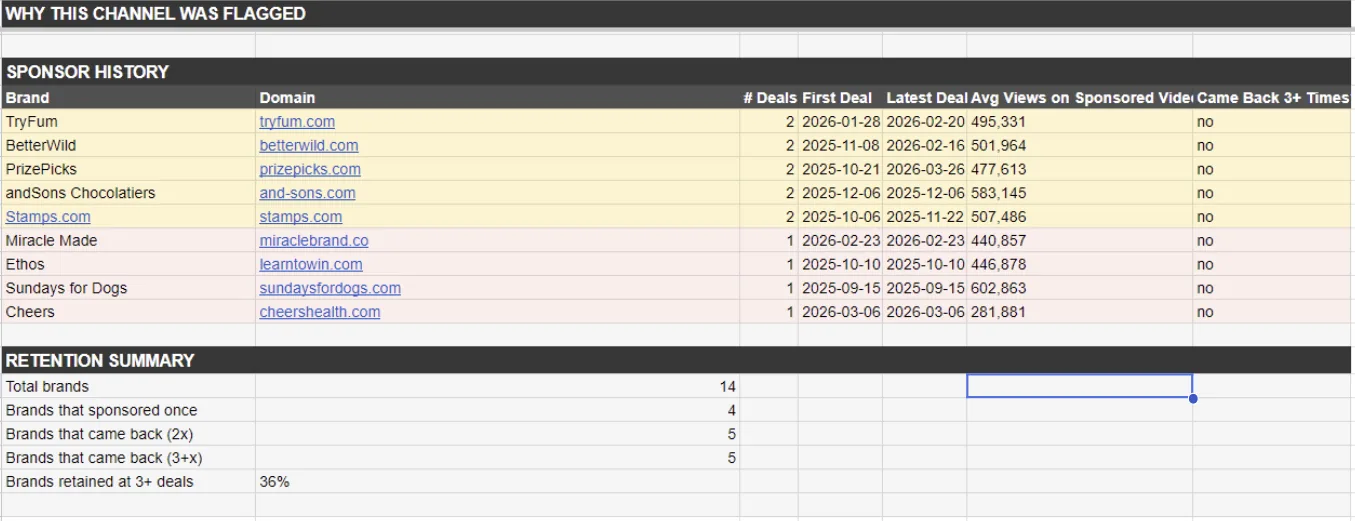
Reach was measured while ignoring subscriber counts, because subscribers are easy to buy, easy to forget, and many channels are over-inflated. Instead, each channel's videos aged older than 30 days but younger than six months - old enough to have collected views, fresh enough to reflect the channel today - were averaged.
By that measure the winners clustered in a healthy view-to-subscriber band of about 0.22 to 0.28: Chris Van Vliet 0.22, Julian Dorey 0.24, Camp Gagnon 0.25, and Triggernometry 0.28. Jesse Michels sat far above at about 0.99, his videos nearly out-pulling his entire subscriber count, a sign of strong search and evergreen reach.
Cast
Reach over subscriber counts
Cast
Ambassadors who grow with us
The aim is not a one-off placement but an ambassador who grows with the brand. A creator at 500,000 subscribers might be at 700,000 next year and millions within five, and an early partnership compounds that trust and reach the whole way up.
The time window matters too. YouTube videos keep gaining views for months, so a last-30-days snapshot understates a channel and overstates a lucky month, which is why a recent multi-month window is used instead.
Cast
The subscriber trap
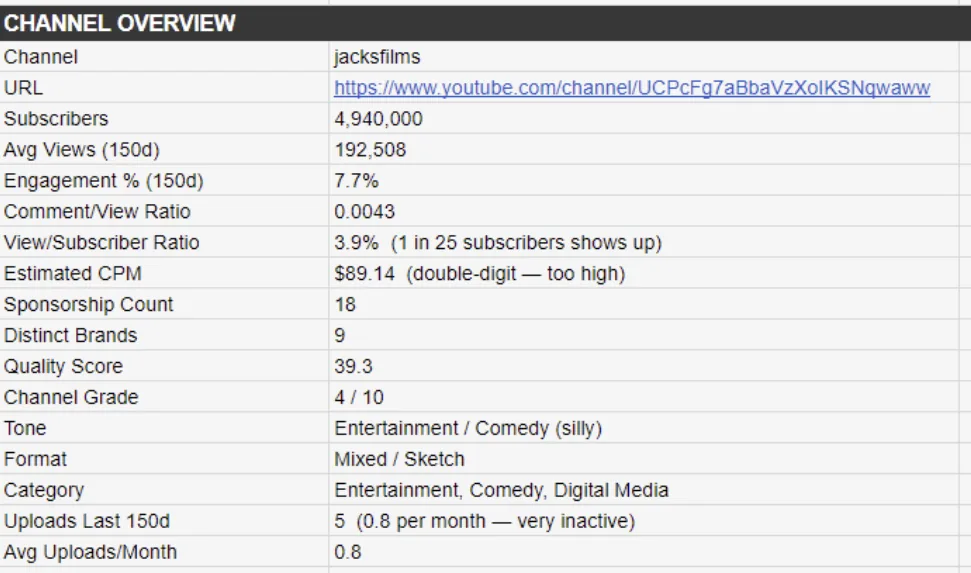
Jacksfilms had almost five million subscribers, yet his videos average only about 192 thousand views, a view-to-subscriber ratio of about 0.04 - far below the shortlist band of 0.22 to 0.28. Even his sponsored videos, which pull better at around 614 thousand, still reach only about an eighth of his base. Paying for five million subscribers when a fraction show up pushes CPM far too high. His comedy audience also skews young, and a cannabis brand needs every viewer to be 21 or older, so he was dropped.
Evergreen content matters too - the how-to videos and deep dives that keep collecting views for years - because an ad inside an evergreen video keeps selling for years.
Cast
A channel's actual numbers at a glance
Cast
When subscribers do matter: whitelisting
Subscriber count is worth focusing on when planning to whitelist or run dark ads (using a creator's handle to run Meta ads); in that case, the more subscribers the better, since the ads reach more of their follower base.
Whitelisting rights for the winners were typically secured, so this was not a concern here. And because the focus was YouTube rather than Instagram - where whitelisting works better - it did not apply to this campaign.
Cast
Comment and authenticity check
The comments came next, because they are the closest measure of what is actually going on with the target audience.
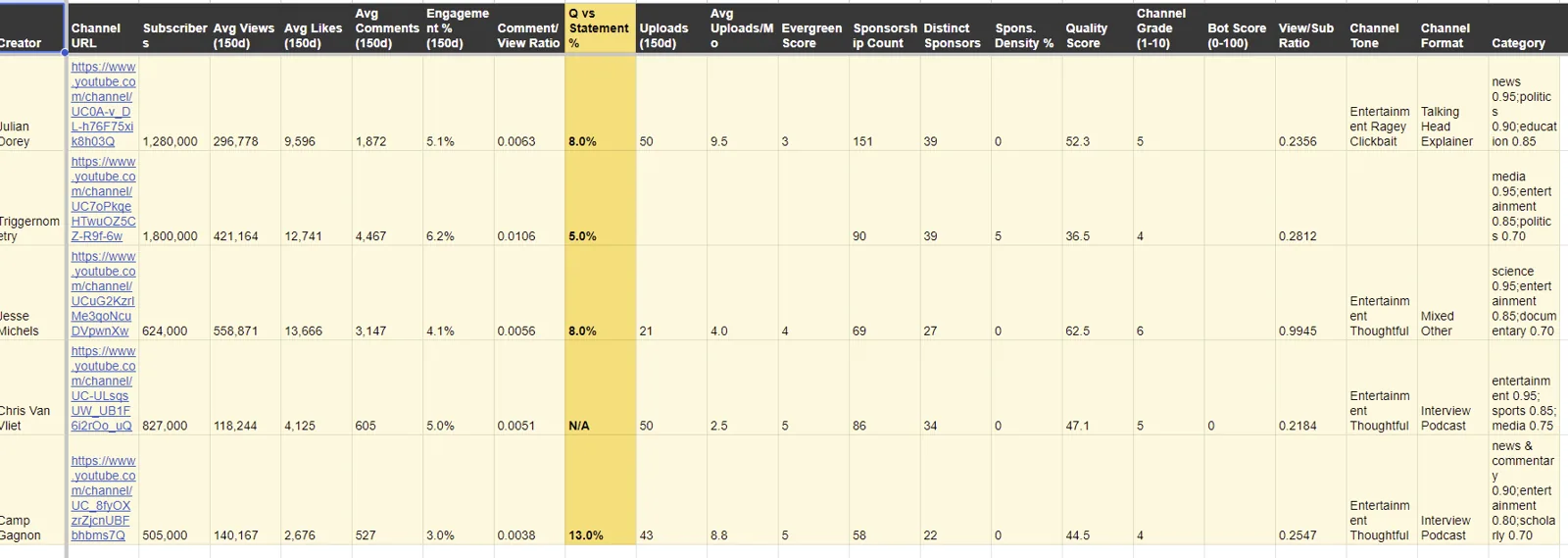
The first check is whether comments are mostly questions or statements. A channel full of random statements usually signals less of an education focus.
Genuine questions often mean the audience wants to learn more and sees the host as a trusted figure. It is a relative measure, so the question-to-statement ratio is taken across ten randomly sampled videos and compared against a batch of the original creators.
Cast
Reading the comments for genuine questions
Cast
Screening for fake followers
Next comes a fake-follower check. Account age is examined at scale, along with account activity. This audit runs against each finalist at selection time and scores every channel from zero to one hundred on how likely it is that bots are watching, based on how many appear in the comments.
Accounts under a year old are typically fake. Each channel is measured against ones known to have no bot followers: a finalist's median commenter account age is compared to that clean set, and it only passes if its commenters are not meaningfully younger.
Cast
How the five cover the funnel
How the five cover the funnel.
Top of funnel, cold reach. Triggernometry (1.80M subscribers, about 421 thousand views per video) and Jesse Michels (about 559 thousand views per video, the highest reach of the five) put Mood in front of hundreds of thousands of viewers who have never heard of the brand.
Middle of funnel, warm consideration. Chris Van Vliet (827 thousand subscribers, 8 brands re-booking three or more times) brings a broad, loyal interview audience that already trusts the host, moving a warm viewer toward a first order.
Bottom of funnel, conversion. Julian Dorey and Camp Gagnon carry the strongest repeat-sponsor signals, with 19 and 9 brands re-booking them three or more times. Their repeat reads, the same host saying it a second and third time, are where the buying actually happens.
Cast
The product sent, and how it is packaged
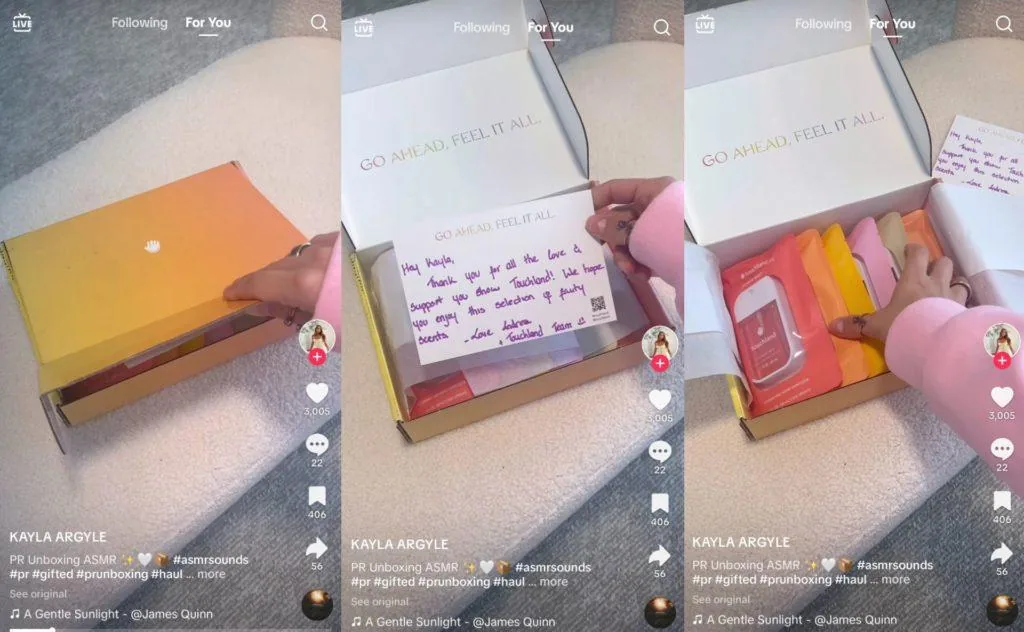
Each creator is sent a one-time-use code to buy the product as a normal customer, which keeps logistics simple, and the effort goes into the packaging. Instead of a plain cardboard mailer, the creator receives a rigid magnetic gift box, a handwritten founder note, the best-selling products, and a printed copy of the creative brief. This lifts conversion and helps earn discounts at scale.
Cast
The gift sent
Step 3 of 5
3. Comply
Keep every video legal
- ›The creator's winning pattern
- ›The legal rules
- ›The locked-down brief
Chart›Cast›Comply›Convert›Compound
Comply
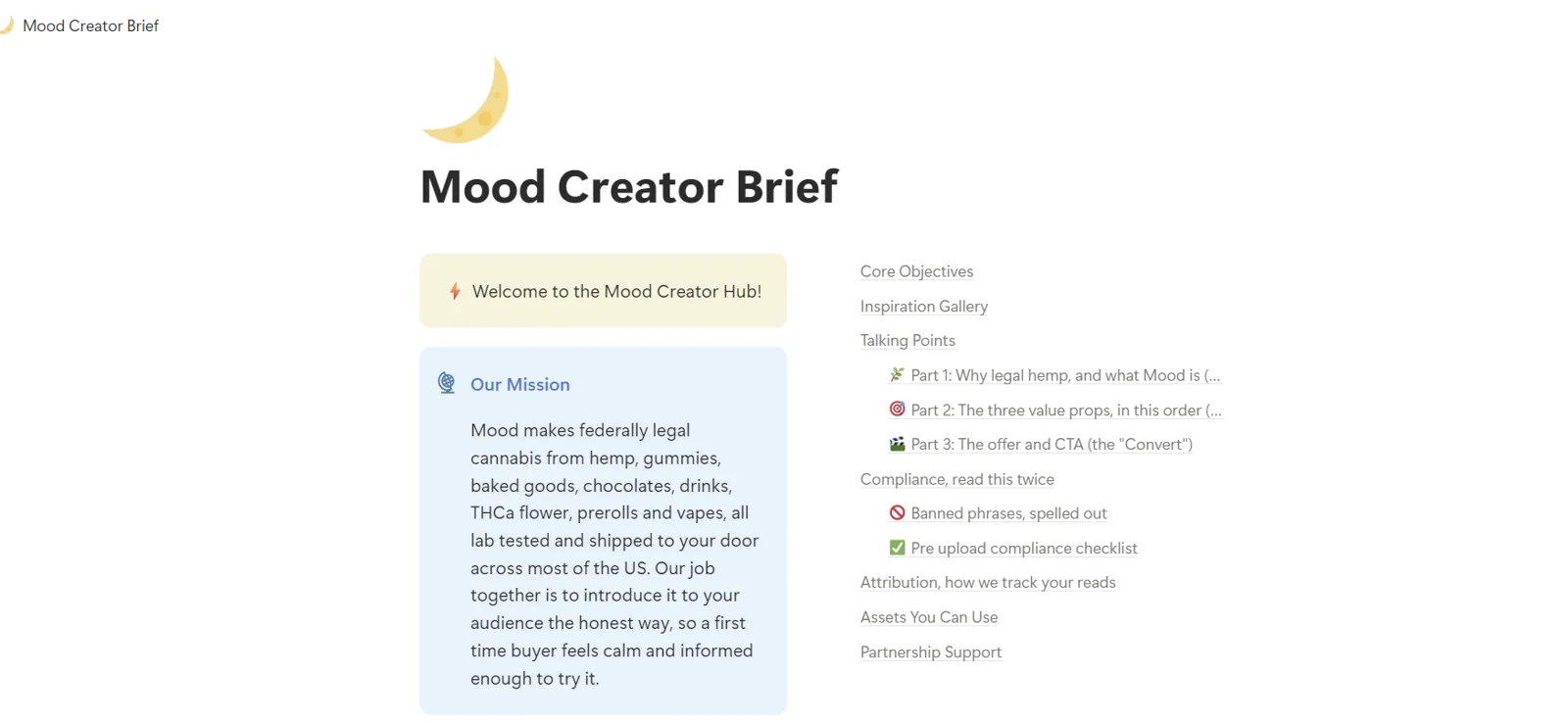
The creative brief
Comply
A brief customised to each creator
The creative brief is customised to each type of creator, because styles differ.
It started by analysing how Julian Dorey ran his own sponsorships - the ones that earned the most repeats. His best-performing partnership was the mattress brand that rebooked him 20 times, and breaking down those reads revealed a consistent pattern.
Comply
Julian Dorey's winning pattern
Built around the reads his audience already rewards
- ✓He used the same personal promo code, JULIAN, across every sponsor.
- ✓He sent viewers to a dedicated landing page at GhostBed.com/julian rather than the generic homepage.
- ✓The read sat early in the episode, and the offer was a flat 25 percent off sitewide.
Those GhostBed reads averaged around 193 thousand views, a sign the buyer was already sitting in his viewer base. The test is simple: if a viewer saw the product on a store shelf, would they buy it? Here, clearly yes. So the brief was built around the three value propositions in order: first, it is federally legal and lab tested; second, it arrives discreetly with no dispensary trip; third, subscribing saves money and is backed by a 100 day guarantee.
Comply
What his Mood read does well
Seven moves from his actual transcript, each mapped to a place in the brief
- ✓Lead with the legal shipping hook: 'ships federally legal THC right to your door.'
- ✓Position against generic gummies: 'forget supplements that only get you high.'
- ✓Sell the outcome, not the ingredient: 'matches exactly the mood you're looking for.'
- ✓Make convenience the pitch: 'no dispensary lines, no awkward conversations.'
- ✓Use specific products: deep work and creativity, PMS support, sexual euphoria.
- ✓Add trust before the CTA: the 100-day satisfaction guarantee.
- ✓Repeat the code clearly: 'promo code Julian,' said more than once.
Comply
Julian Dorey's Mood read, in his words
The transcript the brief was reverse-engineered from
"Did you know there's an online cannabis company that ships federally legal THC right to your door, and has found a way to combine THC with carefully selected functional ingredients to target nearly every mood and health concern you can think of? The company is Mood.com and their line of functional gummies. Right now you can get 20 percent off your first order at mood.com using promo code Julian. Forget one-size-fits-all supplements that only get you high. Mood's functional gummies kick in in as little as 15 minutes and take you to the mood you're looking for, whether that's mind magic gummies for deep work, PMS support, or sexual euphoria gummies. Everything ships discreetly to your door. No dispensary lines, no awkward conversations. Every Mood product is backed by a 100-day satisfaction guarantee, and listeners get 20 percent off their first order with promo code Julian. Head to mood.com and use promo code Julian at checkout."
Watch the read: https://www.youtube.com/watch?v=UIB2T0g8wpE
Comply
The creative brief template
Every brief follows the same spine, filled in per creator (worked example in Notion)
- ✓Welcome and mission: what Mood is (lab-tested, legal) and the audience goal.
- ✓Setup: custom code and link in the first two description lines and the pinned comment.
- ✓Talking points: product, problem, unique mechanism, trust proof, use case, range, risk reversal.
- ✓Offer and CTA: say the code out loud, name the guarantee and subscription savings.
- ✓Compliance: '21 and over,' disclose the ad, exact legal wording, point to the website.
- ✓Banned claims: no cures or treats, nothing on sleep, anxiety or pain, no prescription comparisons.
- ✓Pre-upload checklist, plus a unique tracked code and link per creator.
Comply
The rules to build around
Hemp products must stay under a small THC limit set by federal law, and a new law passed in late 2025 made that limit stricter, so every claim about being legal has to stay current or the campaign ages badly. And these were not just hemp products - most of the line is CBD and THC focused, a much stricter bar for compliance.
Health results can never be promised. This is not as simple as saying nothing - claiming a gummy helps with sleep or anxiety sounds harmless, but the government treats it as a medical claim, which is why the wording had to be handled carefully.
Comply
Age gates, and where ads cannot run
Cannabis advertising also carries an age gate. The audience must skew adult, and the common platform standard is at least 70 percent are 21 or older, confirmed in each creator's own analytics rather than taken on trust. Some states cannot receive shipments at all, so the website carries the age check and the state list, and every video points there instead of trying to explain the law in thirty seconds.
One more thing makes this market special: it is hard to run paid ads on Google, TikTok, and Meta. While most competitors lean on SEO, creator videos are the opening to capture an unsaturated market, as long as every read follows the rules.
Comply
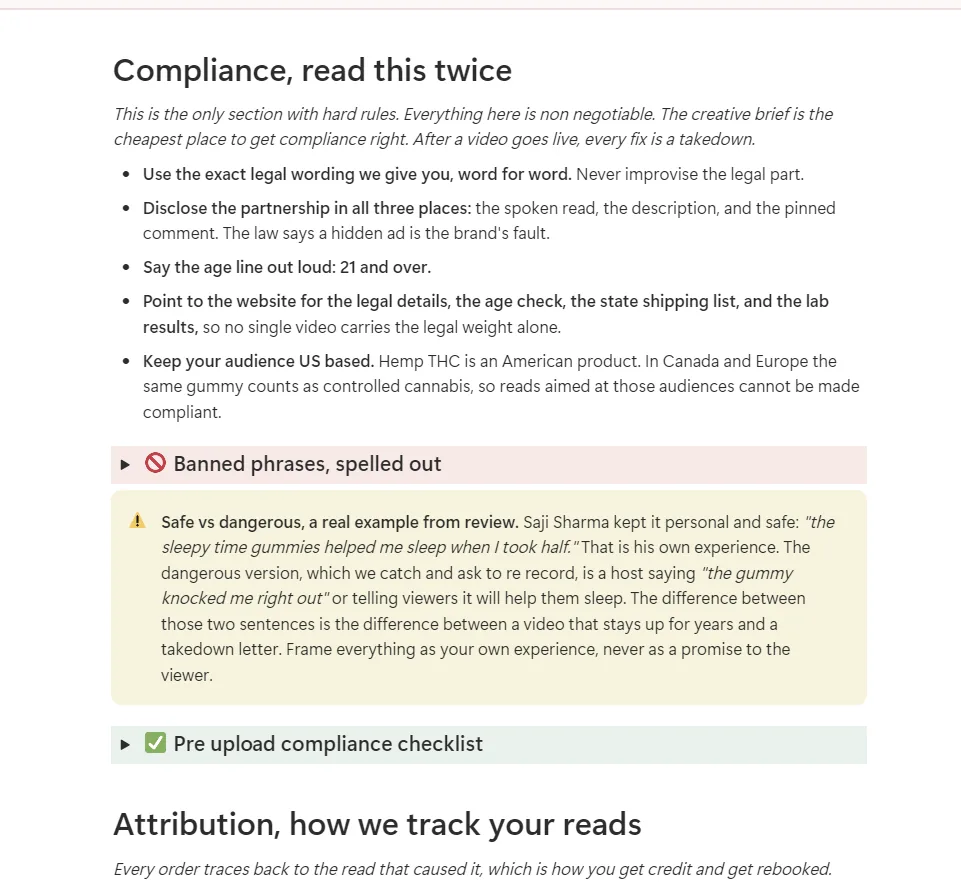
The brief locks down five things
The cheapest insurance against a compliance fine.
- ✓Exact legal wording, word for word, so the creator never improvises the legal part.
- ✓Banned phrases spelled out in full: no cures, no treats, nothing about sleep, anxiety or pain, no promised feelings, no claims about driving or work, and no comparing it to prescription drugs.
- ✓Disclosure in all three places - the spoken read, the description, and the pinned comment - because the law says a hidden ad is the brand's fault.
- ✓The age line said out loud: 21 and over.
- ✓Every video points to the website, where the legal details, age check, state shipping list, and lab results live, so no single video carries the legal weight alone.
Comply
Catch the unsafe line in review
Here is the kind of line caught in review. The safe version keeps it personal: the sleepy-time gummies helped me relax when I took half. The dangerous version is a small step away - a host saying the gummy knocked him right out - which sounds harmless but reads as a medical sleep claim. That step is caught at review, and a re-record is requested before it goes live.
The difference matters: that one video might have had to come down months later, after it stopped earning views, costing money to reshoot and re-engage the creator, and it could have led to a fine. Catching it early kept the campaign safe, especially over a long horizon.
Comply
Safe wording vs a medical claim
Step 4 of 5
4. Convert
Track every sale
- ›Attribution setup
- ›Pixels and retargeting
- ›Lifetime value
Chart›Cast›Comply›Convert›Compound
Convert
Attribution setup
Attribution is one of the most important things to get right, and it gets messy fast because of multi-touch. There are several ways to set it up; the one used here was a coupon code and a UTM tracking link.
The coupon code was JULIAN, for 20 percent off a first order at mood.com. The pattern is what matters: each host carries their own code, almost always their own name, so every order is tagged to the exact channel it came from. Julian Dorey used JULIAN, and each of the other four hosts used their own name the same way.
Convert
The flow, step by step
Earlier reads sweetened it with a free THCa pre-roll on top of the discount, and some sent people to a custom landing page - a seasonal product page, say - rather than the plain homepage, so the click and the code both trace back to one creator.
The flow: the creator reads the code, then points to the link in the description and the pinned comment. The viewer either clicks straight through or types in the website, then uses the code - which they have every reason to do, because it saves them money.
Convert
Pixels, retargeting, and payouts
On click, a Meta pixel and a YouTube pixel both fire, capturing who came in from that channel and UTM link. That data trains retargeting ads later, which convert well because these people already visited the site on the back of a creator they trust. UTM links are combined across creators, so anyone who saw the sponsorship on more than one channel is flagged as a very hot prospect.
On payouts, there are a few ways to handle the coupon code. A Shopify plugin called UpPromote pays each creator their share automatically and logs exactly what they earned; Impact does the same for brands that prefer it, and either one - or custom software - can plug in.
Convert
Why lifetime value is the number that matters
Why lifetime value is the number that matters. A customer who comes in through a creator is worth more than one who comes in through ads - not on day one, but over the months that follow, for three reasons.
- ✓They bought on borrowed trust, so they tend to stick around.
- ✓They keep seeing the product as new creators join the roster.
- ✓And on a subscription, that loyalty compounds into months and months of renewals.
On the first order the two customers look identical, but by month six they are not even close - and that gap decides how much can be spent to win the next creator.
Step 5 of 5
5. Compound
Grow with the winners
- ›Beating saturation
- ›The 85/15 rule
- ›Long-term partnerships
Chart›Cast›Comply›Convert›Compound
Compound
Beating saturation
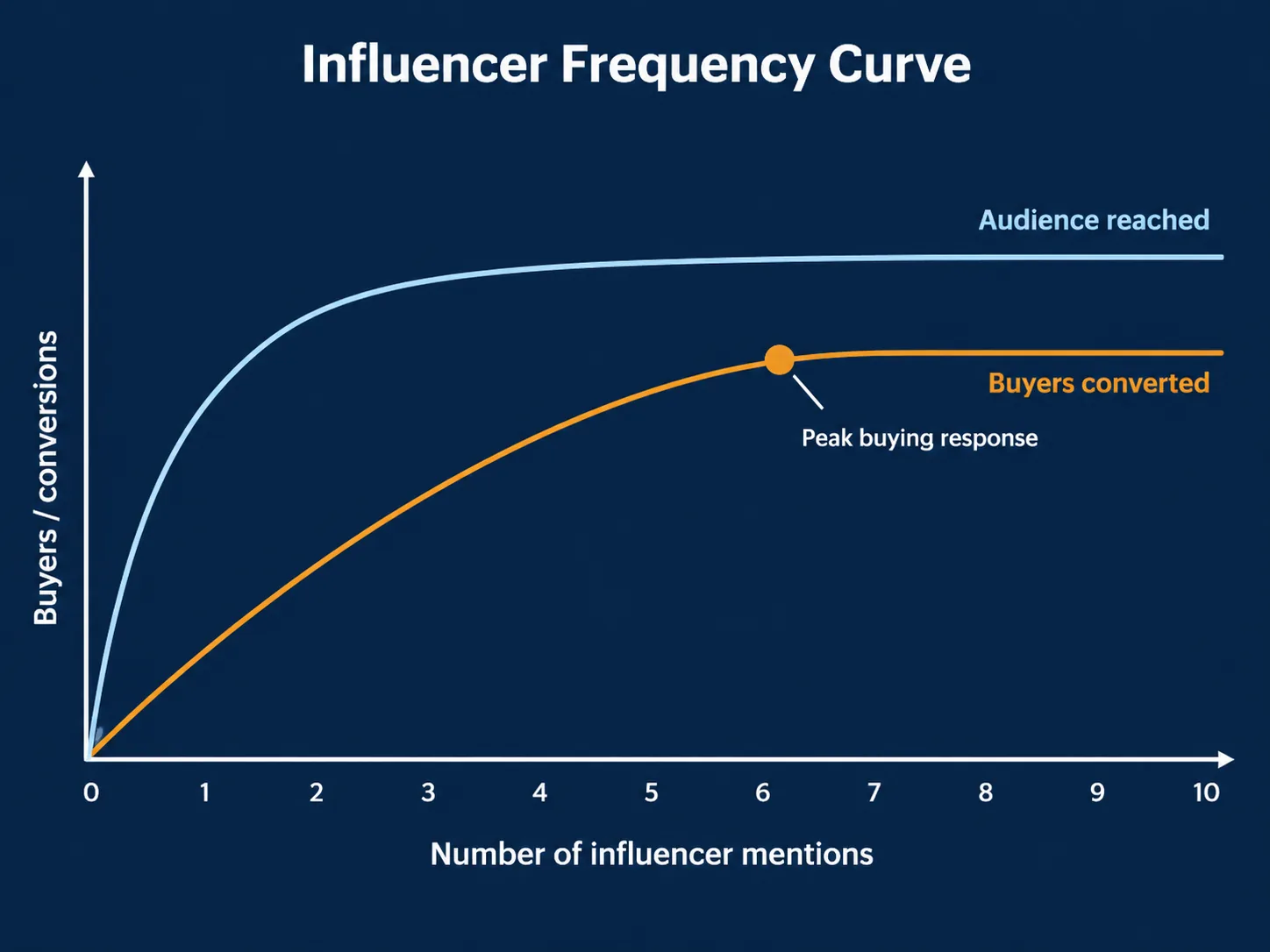
The common worry is that a host's audience saturates after a few drops. But there is a curve between total audience viewing and actual buyers, and the buyer pool keeps refreshing.
Compound
The influence frequency curve
Compound
The 30-day check, and the back end
Each host is judged on how much was earned in the first 30 days, then on the churn of those customers.
Far more money is made on the back end, especially with higher average order values.
Compound
The 85 / 15 rule
Keep winners, rotate the rest
Keep the top 85% of performers; for the bottom 15%, find new people every month. The ones rotated out are used for whitelisting - running paid spend through their handle and reusing their best read as the ad creative.
Compound
Turn creators into long-term ambassadors
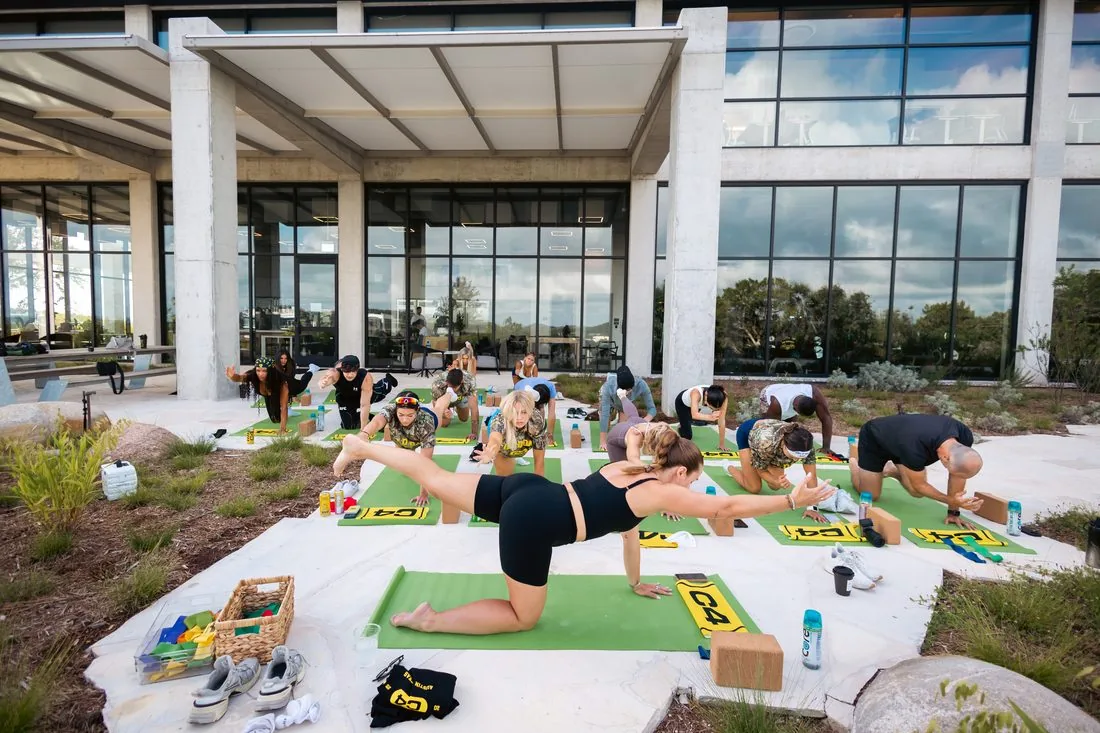
C4 Energy, a DTC energy drink brand, showed how it is done: more than 25 top influencer ambassadors were invited to its Austin headquarters for a field day with new product lines, games and prizes, all built to keep promotion going.
- ✓25+ influencers invited to C4 HQ
- ✓Aerial, branded field games
- ✓"Hit Harder: Alpha Trials" launch
And custom gift boxes sent to each of them.
Compound
C4 Energy's influencer field day
Compound
A launch built around creators

How we work
You will not fill out a form, wait two days, and receive a generic slide deck. Instead:
- ✓You book a call with us, and with 12 other agencies.
- ✓You get all the information before the call. If something looks off, cancel. We do not waste your time and you do not waste ours.
- ✓On the call we cover three things: what you want, whether we can deliver it, and if not, a referral to one of our 24+ agency partners who can.
We match brands with long-term influencer ambassadors that 4x growth over the next few years, using data from 24+ agencies and 600+ creators.
The 5-C System
Chart · Cast · Comply · Convert · Compound
How brands in regulated markets advertise with influencers and stay safe every single time.